


Diamonds have always come with a story about where they formed: deep underground, over billions of years. Lab grown diamonds ask a different question, what if the same crystal could be grown elsewhere, in weeks instead of eons? This guide covers what lab grown diamonds are, how they're made, how they compare to natural diamonds and moissanite, how they're certified, and what to check before buying one.
What Are Lab Grown Diamonds?
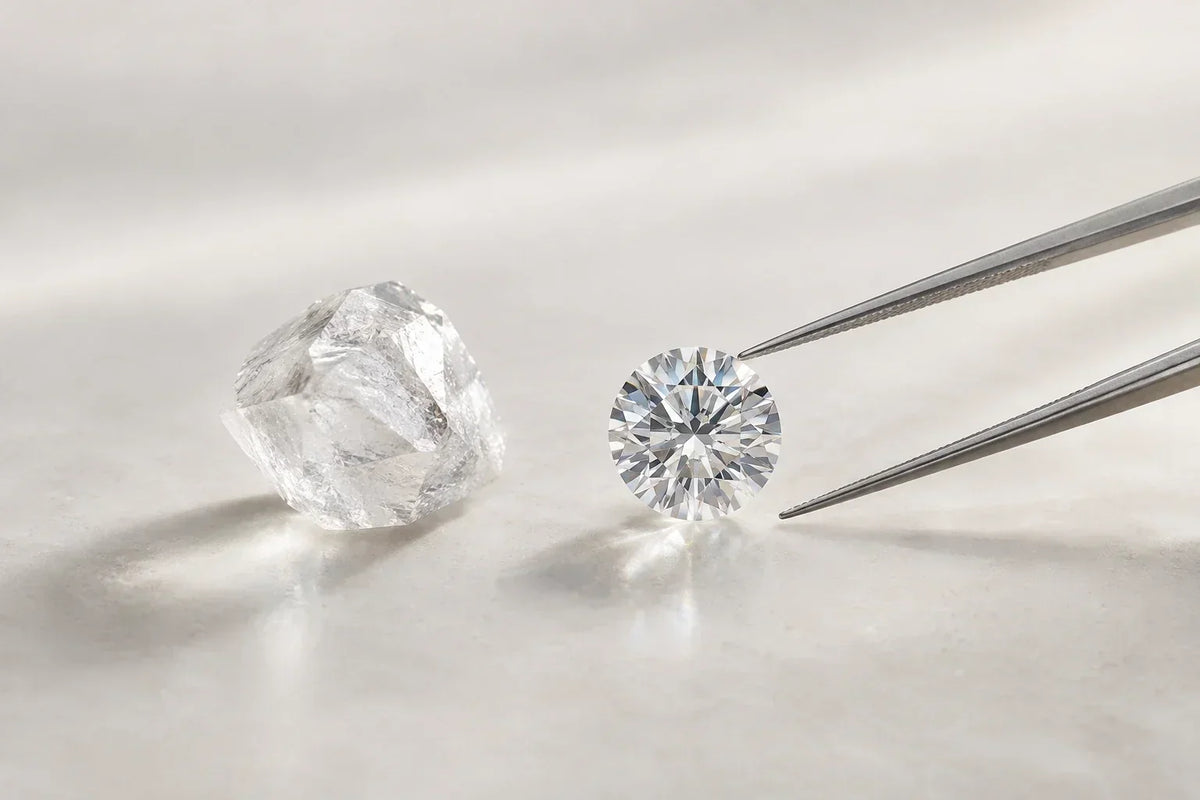
Lab grown diamonds are diamonds grown in a controlled lab using technology that replicates natural diamond formation. Starting from a small diamond seed, they grow layer by layer under intense heat and pressure or through gas-based deposition, until a full crystal forms. Chemically and structurally, the result is identical to a mined diamond, pure carbon in the same cubic lattice. The only real difference is where it formed and how long it took. You'll also see them called laboratory-grown, cultured, or engineered diamonds, all the same thing.
Are Lab Grown Diamonds Real Diamonds?
Yes. This trips people up, but it's settled: a lab grown diamond shares the same composition, crystal structure, hardness and optical properties as a mined one. The FTC and gemological bodies including GIA and IGI classify them as diamonds, not simulants. Origin is what separates the two, not composition, which is why a jeweller's loupe can't tell them apart and certification does the real work.
How Are Lab Grown Diamonds Made?
Two commercial methods exist: Chemical Vapour Deposition (CVD) and High Pressure High Temperature (HPHT). Both start from a diamond seed.
CVD places the seed in a sealed chamber filled with carbon-rich gas, ionised into plasma under heat. Carbon atoms settle onto the seed layer by layer, typically taking a few weeks to a couple of months.
HPHT places the seed in a growth cell with a carbon source and metal catalyst, then applies pressure above 5 gigapascals and heat above 1,300°C, close to the earth's own conditions, so carbon dissolves and redeposits onto the seed. For the full mechanics behind how each diamond is grown, from gas chambers to press machines to growth timelines, How Lab Grown Diamonds Are Made covers that ground properly.
CVD vs HPHT Diamonds
Neither method is universally better, they just produce stones with different typical traits.
|
CVD |
HPHT |
|
|
How it works |
Carbon gas deposited in a plasma chamber |
Carbon melted and crystallised under extreme pressure |
|
Typical traits |
Often Type IIA, may need colour treatment |
Can grow in fancy colours, sometimes metallic inclusions |
|
Identification |
Growth striations under magnification |
Cuboctahedral growth patterns |
What matters more for a buyer is the certification of the individual stone, not which method grew it.
Want to know which type suits you best? Read Types of Lab Grown Diamonds: CVD vs HPHT Explained.
Lab Grown Diamonds vs Natural Diamonds
|
Lab Grown |
Natural |
|
|
Origin |
Grown over weeks to months |
Formed over 1–3 billion years |
|
Composition & properties |
Identical: same hardness, refractive index |
Identical |
|
Price |
Typically 60–95% less |
Higher, driven by scarcity |
|
Resale value |
Generally lower relative to price paid |
Established but usually below retail too |
|
Ethics/environment |
Lower land disturbance, energy use varies |
Mining concerns in some regions, many now certified |
The price gap is the main reason buyers choose lab grown. The rarity and resale argument still tends to favour natural, though that's shifting.
Wondering how the two really compare? Read Lab Grown Diamonds vs Natural Diamonds.
How Are Lab Grown Diamonds Graded and Certified?
Grading uses the same 4Cs as natural diamonds: carat, cut, colour, clarity. Not every certificate carries equal weight, so knowing the issuer matters.
IGI is currently the most active certifier of lab grown diamonds globally, disclosing origin clearly with a laser-inscribed, verifiable report number. GIA is the strictest and most conservative lab in the trade, for both natural and lab grown stones, though it certifies fewer lab grown diamonds than IGI. SGL is another certifying body active in some regional markets; as with any lab, it's worth checking what standards it applies.
Are Lab Grown Diamonds Durable?
Yes. Sharing the same crystal structure as mined diamonds, lab grown stones score a 10 on the Mohs scale, the hardest material used in jewellery. Durability is a property of the material, not the origin; a poorly cut stone of either type can still chip, but the diamond itself won't wear down with normal use.
Do Lab Grown Diamonds Pass a Diamond Tester?
Yes, and this trips people up too. Basic testers check thermal conductivity, and lab grown diamonds conduct heat exactly like mined ones, so they pass. What a simple tester can't do is tell you which is which, that needs lab equipment checking growth patterns and trace elements, the kind labs use, not jewellery counters.
Lab Grown Diamonds vs Moissanite
Moissanite is silicon carbide, not carbon, a diamond simulant rather than a diamond.
|
Lab Grown Diamond |
Moissanite |
|
|
Hardness |
10 (Mohs) |
9.25 |
|
Fire/brilliance |
Balanced, diamond-like |
Higher fire, more rainbow flash |
|
Diamond tester |
Passes as a diamond |
Most modern testers flag it separately |
|
Price |
Higher than moissanite |
Lowest of the three |
If you want an actual diamond at a lower price than mined, lab grown is the closer match. Moissanite is a simulant, not a diamond, and shouldn't be sold as one.
Lab Grown Diamond Resale Value
Both lab grown and natural diamonds typically resell below retail, that's true of diamond jewellery generally. Lab grown stones currently see a steeper discount, largely because falling production costs pull resale value down with them. This isn't fixed for every stone or market, and some retailers, Cosmos included, offer buyback or exchange programmes specifically to address this gap, terms worth checking before you buy from anyone.
History of Lab Grown Diamonds
The first reproducible diamond synthesis happened in 1954, when General Electric grew one using an early HPHT process, though for decades output stayed industrial-grade. CVD became commercially viable for gem-quality stones in the early 2000s, and by the mid-2010s both methods could reliably produce jewellery-grade diamonds at scale. Since then, costs have fallen sharply, and brands like Cosmos have built entire businesses around lab grown diamond jewellery.
For the full story of how lab-grown diamonds went from lab experiment to jewellery mainstay, read Do You Know the History of Lab Grown Diamonds?
Are Lab Grown Diamonds Ethical and Sustainable?
It depends on the producer, not the category. Lab grown diamonds avoid the land disturbance and documented labour issues tied to some mining, but growing one takes real energy, and its footprint depends heavily on the power source behind it. Not every grower discloses this, so "sustainable" claims are worth checking rather than assuming. Equally, not every mined diamond is unethical, many now move through certification frameworks like the Kimberley Process, which has its own limits. The honest answer is that both categories span a range of practice, and the specific producer matters more than a blanket label.
How to Choose a Lab Grown Diamond
Check the certification, IGI, GIA or another recognised lab, with a verifiable report number.
- Understand the 4Cs for that specific stone, cut quality affects appearance more than most buyers expect.
- Check the metal, look for BIS hallmarking or an equivalent standard.
- Check exchange and buyback terms, this matters more here given how lab grown resale works.
- Verify, don't just trust the brand. Cosmos Lab Grown Diamonds requires independent certification (IGI, GIA or SGL) on every piece and BIS hallmarked gold, alongside an exchange-anytime policy, the kind of transparency worth looking for anywhere you buy.
Caring for Your Lab-Grown Diamond
A lab-grown diamond needs exactly the same care as a mined one - its hardness, durability and daily-wear resistance are identical, so there's nothing special or extra to worry about. A little routine care, though, keeps any diamond piece looking its best over years of wear. For a full breakdown of cleaning, storage and everyday do's and don'ts, read How to Take Care of Diamond Jewellery.
FAQs
Are lab-grown diamonds real diamonds?
Yes. Every Cosmos lab grown diamond is pure crystallised carbon, physically and optically identical to a mined diamond.
What is the difference between lab-grown and natural diamonds?
Only the origin. We grow ours in a few weeks; natural diamonds form underground over a billion years.
How are lab-grown diamonds made?
We place a diamond seed in a sealed chamber with carbon-rich gas and grow it using CVD.
Can jewellers tell the difference between lab-grown and natural diamonds?
Not by eye. Instruments and the certificate confirm origin, and every Cosmos stone is clearly marked lab-grown.
Are lab-grown diamonds certified?
Yes. Every Cosmos diamond ships with an IGI, GIA or SGL report documenting cut, colour, clarity and carat.
Are lab-grown diamonds as durable as natural diamonds?
Yes. They score 10 on the Mohs scale, the same as mined. Cosmos pieces handle daily wear easily.